LOGISTICS PLATFORM
Modernising national logistics through AI powered automation
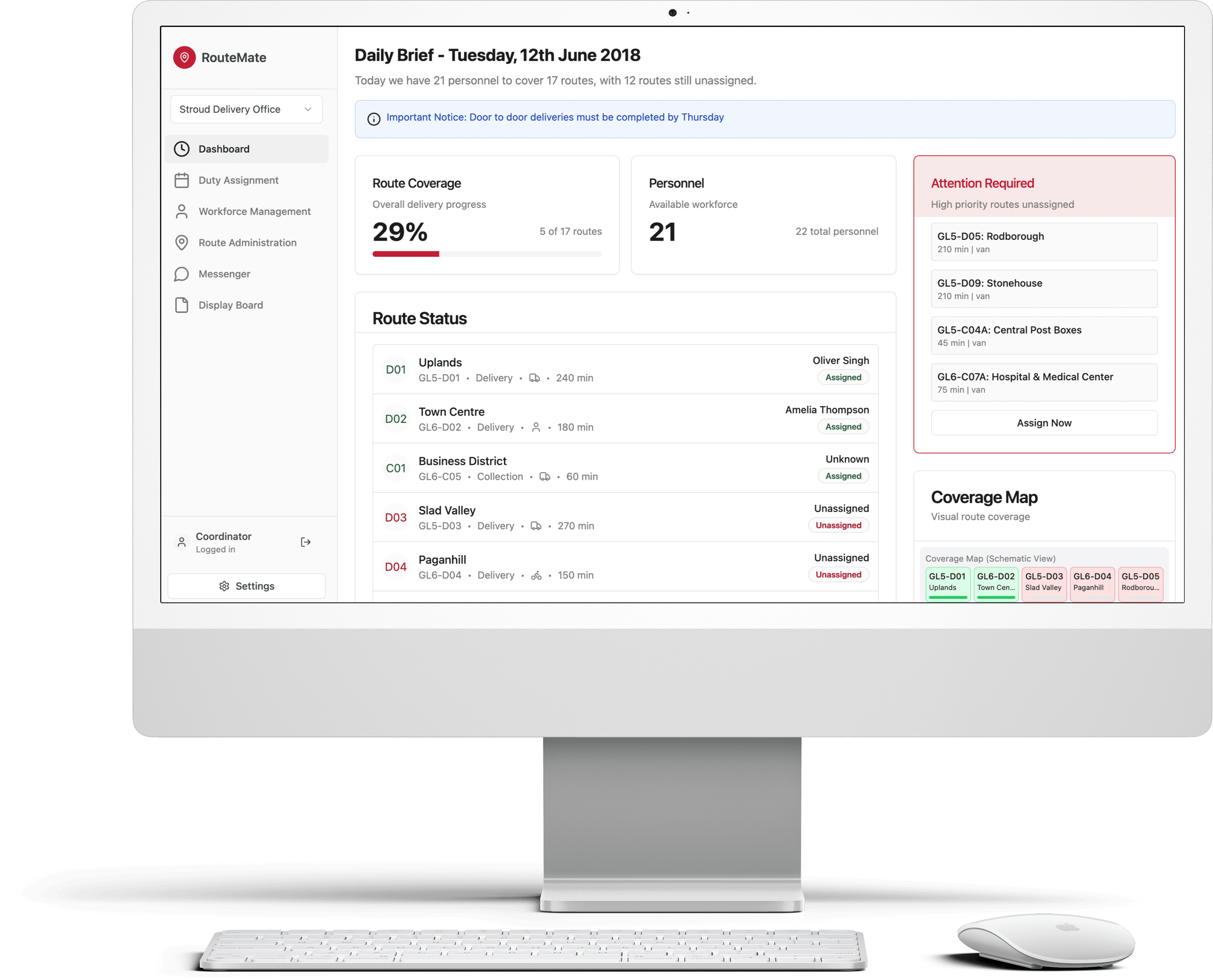
Route planning was entirely manual, relying on physical whiteboards, local knowledge and personal mobile phones to coordinate daily delivery operations. Communication with field personnel relied on personal phones, with no visibility across office operations.
Key issues:
To ensure we built a tool that would genuinely improve workflows, I led a discovery phase involving site visits, interviews, and process shadowing across multiple delivery offices:
💬
Shadowing Delivery Coordinators
I spent time with office managers during morning planning sessions to observe how they used their whiteboards. These sessions revealed that nearly all assignment decisions were held in people’s heads, with limited written records. Skills, shift lengths, and route complexities were remembered informally or jotted down inconsistently. Updates due to sickness or breakdowns required chain-calling several staff, adding to the time burden.
📌
Whiteboard Mapping Workshops
I facilitated workshops with operational teams to map existing workflows, uncover decision-making patterns and identify where automation could remove unnecessary manual effort while retaining operator control. This helped us understand the hierarchy of decision-making and the mental models used to assign routes - things like “Emma’s always on GL5-D03 because she knows that hill” or “if someone’s on bike, don’t give them over 180 minutes.”
🧩
Key Insight: No Real-Time Visibility
One of the most surprising insights was how little real-time visibility staff had once a shift began. Once delivery personnel were out on the road, there was no consistent way to reach them unless you had their personal phone number. Breakdowns, missed parcels, or emergencies were often handled via multiple, inefficient calls. There was also no central record of route assignments once the whiteboard was wiped clean at the end of the day.
🧠
Mental Load + Manual Effort
= Burnout
Perhaps the strongest finding was the cumulative strain on coordinators. Matching people to routes manually every day - factoring in training, shift type, duration, and transport method - led to visible stress, especially during busy periods or unexpected absences. The consistent message was clear: automate the repetitive decisions, but keep people in control when judgement mattered.
Rather than digitising the whiteboard, we redesigned the entire workflow around automation, operational visibility and real-time communication while allowing coordinators to override decisions when needed.
Key features:
Workforce Management
Centralised workforce profiles, skills and availability to automate route planning while maintaining operational flexibility.
Route Admin
Capture route details (code, name, duration, format, priority), with filtering and search.
Duty Assignment
Automated route assignment using workforce skills, availability, route duration and transport constraints, while preserving manual overrides for local judgement.
Messenger
Real-time chat with field personnel, integrated with new postal digital assistant devices (no personal phone needed).
Display Board Mode
Replaced static whiteboards with live operational dashboards, creating a single source of truth for every delivery office.
Reporting & Insights
The platform also created structured operational data that could later support predictive planning, demand forecasting and smarter disruption management.




After a successful 12 week pilot across 3 delivery offices, RemoteMate was deployed in over 80 offices nationally across a 8 month period, positively impacting over 2,800 postal operators…
Time saved
Reduced daily planning by over 40%
Compliance
Failure to cover all planned routes reduced by over 85%
Accuracy
100% alignment of routes to skilled staff
Visibility
Both local coordinators and regional management have full oversight of staff and route coverage
Adoption
All offices requested access within 2 weeks of the pilot launch!